
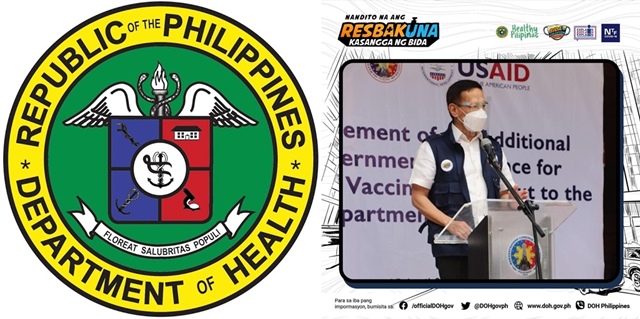
Department of Health (DOH) Secretary Francisco Duque III, accompanied by top DOH officials, conducted an inspection of four hospitals in the National Capital Region (NCR) to determine their readiness to accept COVID-19 patients.
The four facilities include the National Center for Mental Health (NCMH), the Lung Center of the Philippines (LCP), the National Kidney and Transplant Institute (NKTI), and the off-site extension of Jose R. Reyes Memorial Medical Center (JRRMMC) at Quezon Institute that will help increase its response capacity to COVID-19.
Sec. Duque, Undersecretary Leopoldo Vega, Assistant Secretary Romeo Ong, and Assistant Secretary Elmer Punzalan visited the NCMH last April 12 as it opened some of its pavilions to cater to COVID-19 patients, while ensuring the continuity of care for psychiatric in-patients. The pavilions contributed a total of 960 additional beds dedicated to the treatment and recuperation of patients with mild and moderate COVID-19 symptoms. NCMH also allocated 3 ICU beds for severe COVID-19 cases. Meanwhile, a separate pavilion has been dedicated to the treatment of psychiatric in-patients who also need COVID-19 care. NCMH also collaborated with hotels in the vicinity to provide isolation and quarantine facilities for its health care workers.
The officials also visited QI Modular Hospital, LCP, and NKTI where health workers from Visayas and Mindanao have been stationed. These are critical resource augmentations, especially in the context of rising healthcare utilization rates in highly urbanized areas.
“We are grateful to both our hospitals and our healthcare workers for continuously providing their services to treat COVID-19 patients. While our hospitals and our healthcare workers have traditionally had their own specialties and service streams, the recent rise in COVID-19 cases in the NCR+ area necessitated adjustments and additional resources to capably complement our ongoing response efforts,” Sec. Duque said.
Sec. Duque further emphasized that the augmentations being made to the country’s health capacity should not be interpreted as a signal to become complacent in the adherence to public health standards. Prevention remains to be the best method of slowing and preventing the further spread of COVID-19, especially in homes, communities, and public spaces, Sec. Duque explained.
“Our hospitals are our final line of defense. We go to hospitals when we need medical care. But, there are things that we can do at a personal level, in our homes or offices, that can help prevent COVID-19 infection. By simply wearing a face mask properly and whenever necessary, and by avoiding unnecessary travels, we reduce our chances of getting infected or us transmitting the virus,” Sec. Duque concluded.