
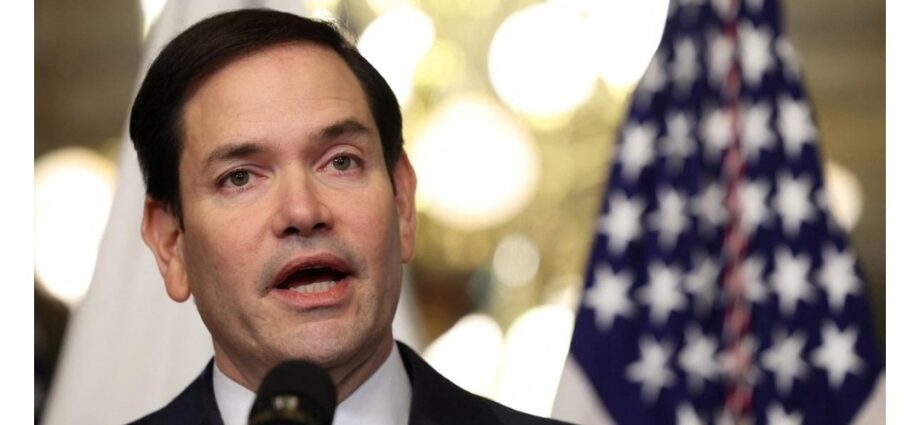
On his first full day in office, US Secretary of State Marco Rubio met with his counterparts from Japan, India, and Australia, issuing a strong statement against coercive actions in Asia. While not naming China explicitly, the joint statement served as a clear warning against Beijing’s assertive actions in the region.
The meeting, held in Washington a day after President Donald Trump’s inauguration, highlighted the Quad’s commitment to countering China’s rising influence. Trump, who has pledged to confront Beijing’s growing power, contrasts this stance with his contentious approach to traditional US allies, as demonstrated by his renewed threats of tariffs against the European Union on the same day.
Commitment to a Free Indo-Pacific
In a joint statement, Rubio and his Quad counterparts reaffirmed their goal of promoting a “free and open Indo-Pacific,” a diplomatic term used by successive US administrations to signal opposition to Chinese aggression.
The ministers expressed support for a region “where the rule of law, democratic values, sovereignty, and territorial integrity are upheld and defended.” They added, “We also strongly oppose any unilateral actions that seek to change the status quo by force or coercion.”
Plans for an India Summit
The Quad leaders also announced plans to hold a summit in India later this year, marking an opportunity for an early visit by President Trump to the growing US ally. India is viewed in Washington as a key counterbalance to China.
Trump developed a strong rapport with Indian Prime Minister Narendra Modi during his first term, highlighted by a massive rally the two leaders held together at a cricket stadium.
Addressing Regional Tensions
The Quad meeting comes amid heightened tensions between China and the Philippines, a US ally, over territorial disputes in the South China Sea. Rubio, during his Senate confirmation hearing, vowed to deter China from invading Taiwan, the self-governing democracy Beijing claims as part of its territory.
Trump has previously stirred controversy by suggesting that Taiwan should pay the US for its defense, while his Defense Secretary nominee, Pete Hegseth, faced criticism during confirmation hearings for being unable to name a member of ASEAN (the Association of Southeast Asian Nations).
The Evolution of the Quad
Originally envisioned by the late Japanese Prime Minister Shinzo Abe, the Quad was elevated to a leaders’ summit under former President Joe Biden. While the grouping has received backlash from Beijing, which views it as a US-led effort to contain China’s rise, it continues to solidify its role as a counterweight to Chinese influence in the Indo-Pacific.
China’s Response
China has consistently criticized the Quad, accusing it of being a geopolitical strategy aimed at encircling the Asian power. However, Quad leaders have maintained that their cooperation seeks to promote regional stability, adherence to international law, and the safeguarding of democratic values.
As tensions persist, the Quad’s unity underscores its resolve to address challenges posed by China while advancing the shared interests of its member states in the Indo-Pacific.