
THE Philippine National Police (PNP) stands to gain the most as the biggest beneficiary of the Military and Uniformed Personnel (MUP) pension reform, according to the proposed measure’s principal author.
House Ways and Means Chair Joey Sarte Salceda (Albay, 2nd district) says that the PNP will benefit the most from the proposed MUP pension reform, which the House has already approved on 3rd reading and is currently pending discussions in the Senate.
He added that under the proposed law, total permanent disability will be given full retirement benefits.
Salceda, who also chairs the House Ad Hoc Committee on the MUP Pension System says that “those who are totally permanently disabled and the survivors of those who are killed in action will now be entitled to the same retirement and survivorship benefits that other MUP are entitled to.”
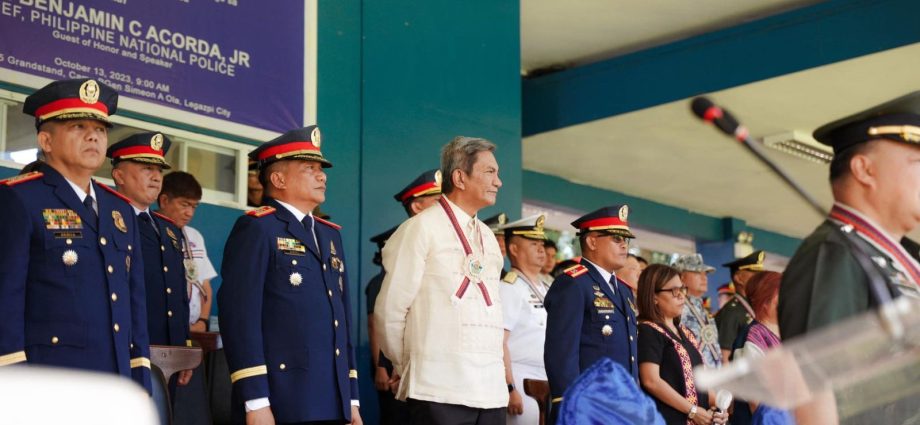
“This benefit is long overdue, and recognizes that policing remains a high-risk occupation even when the PNP has moved to civilian control and supervision. The families of those who lose their lives in the preservation of peace and order can at least expect a pension from a grateful nation,” Salceda said in a statement after the celebration of the 122nd Anniversary of the Police Service at Camp General Simeon Ola in Legazpi City and was presided over by PNP Chief PGen. Benjamin Acorda, Jr.
Salceda adds that he is open to making the retirement benefit “retroactive” since the PNP is still a young force.
“I know the risks involved in policing at a very personal level. One of two police officers shot dead last July while on patrol in Oas was my personal security officer, Police Chief Master Sgt. Joseph Ostonal. The other was Police Corporal Jeffrey Refereza. Hopefully, we could come up with some way to make at least the eligibility for at least some of these benefits retroactive. With instructions from PNP Chief Acorda, Brigadier General Niño David Rabaya is working with us on these issues,” Salceda said.
Salceda adds that the PNP also stands to gain the most from the proposed three-percent guaranteed annual salary hike for ten years under the proposed measure.
He said that being the largest uniformed service, the PNP also stands to gain the most from a sustainable pension system. Apart from fully retaining the structure of the existing pension system for active and retired personnel, the solon said the MUP Pension Reform Act also guarantees a three-percent annual increase in salary over the next ten years, which he estimated to be as much as 47.6 percent of the total benefits from the salary increase will accrue to members of the PNP.
Salceda cited that the Committee maintained “an open mind” about MUP benefits despite the initial position of economic managers towards a fully funded pension system.
“Among all the uniformed services of the country, it is the Philippine National Police which has undergone the most transformation – in parallel with the country’s own evolution as a nation-state. Charged with the ‘preservation of peace and order’ in the 1987 Constitution, the Philippine National Police is a pillar of the country’s security architecture. In fact, one could argue that by age, the Philippine National Police is our most senior uniformed service by age, tracing its roots to the Philippine Constabulary created by Act No. 175 in 1901.”
He said that it is for these reasons that they considered the key role of a strong and high-morale police force in the crafting the MUP Pension Reform Act, which he said was an assignment given to him by President Marcos and the House leadership, headed by Speaker Romualdez, and successfully defended a reform that was acceptable to all major stakeholders.
“Officials of the PNP have called the House version a morale boost. The bill is now in the Senate, most likely to be approved into law by this year, given President Marcos’s strong support.”