
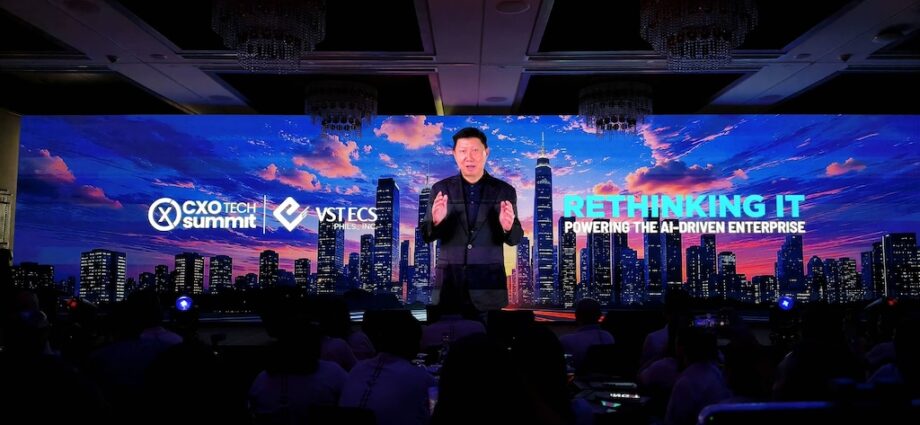
Philippine businesses must accelerate their adoption of artificial intelligence (AI) to remain competitive in the global market, even as rising hardware costs, cybersecurity threats, and aging IT infrastructure present challenges to digital transformation.
This was the central message of technology industry leaders during the VST ECS CXO Tech Summit 2026, which brought together executives from major global technology companies to discuss the future of enterprise IT, AI adoption, cybersecurity, and the infrastructure needed to support increasingly digital business operations.
The discussions highlighted a growing consensus that AI is no longer an experimental technology or an optional investment but an essential business capability that enterprises must integrate into their long-term strategies.
VST ECS Philippines President and Chief Executive Officer Jimmy Go acknowledged that the Philippines remains behind several Southeast Asian neighbors in adopting enterprise AI, particularly in deploying specialized servers and supporting infrastructure.
“The Philippines is kind of late in this AI revolution,” Go said, noting that Singapore began seeing significant commercial activity from AI server deployments approximately two years ago, followed by Malaysia and Thailand.
He expressed optimism that investments in AI infrastructure, data centers, and hyperscaler operations would eventually gain momentum in the Philippines.
However, Go cautioned businesses against waiting for AI technologies to mature completely before making investments, emphasizing that IT has become a critical component of business competitiveness rather than simply an operational expense.
VST ECS has also started integrating AI into its own business operations, investing in dedicated AI servers and incorporating AI capabilities into enterprise software applications.
Building the right infrastructure for AI
Industry executives emphasized that successful AI implementation requires organizations to modernize their existing IT infrastructure before investing heavily in advanced computing technologies.
Daryush Ashjari, Asia-Pacific and Japan Chief Technology Officer and Vice President for Solution Engineering at Nutanix, compared deploying AI on outdated infrastructure to driving a high-performance sports car on a gravel road.
He explained that even the most advanced AI systems would struggle to deliver their full potential without an appropriate technological foundation.
Rather than immediately replacing all existing systems, Ashjari recommended that enterprises develop modernization roadmaps that allow legacy infrastructure to coexist with emerging AI workloads while gradually transitioning to more capable platforms.
Matthew Yeo, Global Engineering Technologist at Dell Technologies, likewise cautioned businesses against purchasing expensive AI hardware without identifying specific business applications.
Yeo disclosed that fewer than 10 of the initial 4,000 AI solutions evaluated by his organization eventually reached full production deployment.
The experience illustrates how enterprises can waste significant resources when they invest in graphics processing units, servers, and AI software without clearly defined objectives or measurable performance indicators.
For small and medium enterprises, Yeo recommended starting with limited pilot projects, evaluating their results, and expanding only those applications that demonstrate tangible business benefits.
Rising hardware costs complicate investments
Another concern raised during the summit was the increasing cost of enterprise hardware as worldwide demand for AI computing infrastructure continues to grow.
Go warned that strong demand for memory modules, solid-state drives, graphics processing units, and other semiconductor components has placed upward pressure on hardware prices.
These increases affect not only AI servers and enterprise storage systems but also consumer devices such as laptops and smartphones.
While manufacturers continue to provide delivery estimates, Go acknowledged that supply constraints and longer lead times could complicate technology procurement and investment planning.
Walter So, Managing Director at HPE, suggested that businesses consider flexible IT consumption models to reduce the financial burden of infrastructure modernization.
Instead of purchasing expensive computing systems outright, enterprises can adopt private cloud solutions that allow them to pay for computing resources according to actual consumption.
Such arrangements could help organizations manage capital expenditures while gradually expanding their AI capabilities.
Harold Lim, Country Solutions Head at APC by Schneider Electric Philippines, meanwhile, highlighted the physical infrastructure requirements of AI computing.
He explained that high-performance AI systems demand substantial electrical power and sophisticated cooling technologies, including liquid cooling, to maintain operational reliability.
Without sufficient power capacity and appropriate cooling systems, organizations risk operational disruptions and additional infrastructure expenses.
Cybersecurity risks grow alongside AI adoption
As enterprises increasingly integrate AI into their operations, cybersecurity must remain a central consideration, according to Bambi Escalante, Country Manager at Fortinet Philippines.
Escalante warned that the transition from conventional generative AI applications to autonomous AI agents introduces new security challenges requiring stronger governance and monitoring.
Organizations must establish visibility over unauthorized or unapproved AI tools, commonly described as shadow AI, while implementing identity management, role-based access controls, and zero-trust security principles.
She also emphasized the importance of continuous monitoring and layered security defenses as AI systems become more deeply integrated into business processes.
Citing threat intelligence indicating approximately 20,000 automated vulnerability scans per second, Escalante noted that cybercriminals are increasingly using automation and AI to identify potential targets and exploit security weaknesses.
The growing sophistication of cyberattacks means that smaller businesses can no longer assume they are unlikely targets.
Escalante stressed that organizations should also consider AI-powered cybersecurity tools capable of identifying and responding to increasingly automated threats.
Data readiness and workforce training remain essential
Beyond hardware and cybersecurity, industry leaders identified data management and employee readiness as critical factors in determining whether AI investments generate meaningful returns.
Go emphasized that enterprises must first organize and properly manage their business data before expecting AI systems to deliver reliable insights and automate workflows.
Poor data quality, fragmented information systems, and inadequate governance can undermine the effectiveness of even the most sophisticated AI applications.
He also expressed optimism that clearer policies governing data sovereignty and local data residency could encourage further investment in Philippine data centers and sovereign cloud infrastructure.
Ida Ong-Co, Managing Director at HP Philippines, stressed that investments in AI technologies must be accompanied by workforce development.
She highlighted HP’s AI Academy initiative, which provides training programs tailored to an organization’s level of AI readiness.
The initiative also extends AI education to teachers, helping educators introduce AI literacy and related digital competencies into classroom instruction.
Ong-Co encouraged business leaders to prioritize practical productivity improvements and measurable outcomes rather than implementing AI merely to follow technology trends.
VST ECS expands enterprise technology support
To help Philippine businesses address these challenges, VST ECS is expanding its portfolio of enterprise technology solutions and strengthening its technical support capabilities.
Cherry Centeno, First Vice President and Group General Manager for Value Business at VST ECS Philippines, said the company has added more than 20 specialized solutions to its portfolio.
The distributor also maintains a technical workforce of more than 300 pre-sales and post-sales engineers who assist customers in designing, evaluating, and implementing enterprise IT solutions.
Centeno highlighted the company’s experience and demonstration centers, where enterprises can explore different technology configurations and conduct proof-of-concept testing before committing to large-scale investments.
These facilities allow organizations to assess whether proposed solutions can meet their operational requirements while reducing the risks associated with costly technology deployments.
Although the Philippines may be entering the enterprise AI investment cycle later than neighboring markets, industry executives believe local organizations have an opportunity to learn from earlier deployments in other countries.
By studying successful implementations and avoiding costly experimentation, Philippine enterprises could accelerate their adoption of proven AI applications.
Ultimately, the discussions at the VST ECS CXO Tech Summit 2026 underscored that successful AI adoption will depend not on how much businesses spend on technology, but on how effectively they modernize their infrastructure, secure their systems, prepare their workforce, and translate AI investments into measurable business value.
For Philippine enterprises, the challenge is no longer whether to adopt artificial intelligence, but how quickly and strategically they can put it to work.