
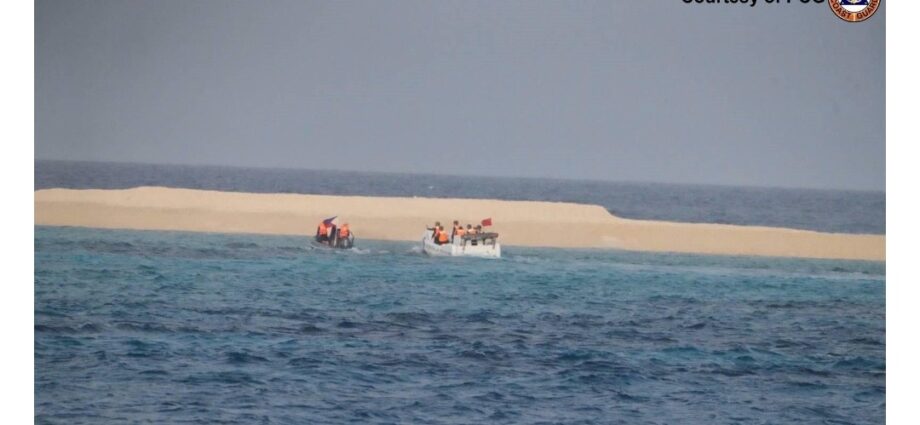
Title Philippine Coast Guard (PCG) reported on Saturday that vessels of the China Coast Guard (CCG) and the People’s Liberation Army-Navy (PLAN) harassed Bureau of Fisheries and Aquatic Resources (BFAR) ships on their way to Sandy Cay in the West Philippine Sea.
The incident occurred on Friday while BFAR vessels BRP Datu Pagbuaya and BRP Datu Bankaw were conducting a marine scientific survey and sand sampling mission.
According to the PCG, three Chinese Coast Guard vessels (CCGVs 4106, 5103, and 4202) executed aggressive maneuvers, violating the Convention on the International Regulations for Preventing Collisions at Sea, 1972 (COLREGs). Despite this, the skilled seamanship of the BFAR crew averted potential collisions.
Additionally, four small boats from the CCG harassed two rigid hull inflatable boats (RHIBs) transporting personnel to Sandy Cay. The situation escalated further when a PLAN helicopter, tail number 24, flew at an unsafe altitude above the RHIBs, creating hazardous conditions with its propeller wash.
Due to the continuous harassment, the BFAR and PCG were forced to suspend their survey operations, leaving them unable to collect sand samples at Sandy Cay.
“This continuous harassment and blatant disregard for safety by the Chinese maritime forces left the BFAR and PCG with no choice but to halt their mission,” the PCG said in a statement. “Nevertheless, both BFAR and PCG remain committed to their mandates, ensuring the safety of personnel and vessels in the pursuit of scientific research and resource management.”
This is not the first reported incident of Chinese harassment in the area. In September 2023, crushed and dead corals were found at Sandy Cay 2, a practice experts associate with China’s reclamation activities. In March 2024, Filipino scientists were injured after being harassed by a low-flying Chinese Navy helicopter during a similar operation.
Sandy Cay, also known as Pag-asa Cay, has been reported to be in a degraded ecological state. Experts have attributed this to overfishing, climate change impacts, and island-building activities.
China claims nearly the entire South China Sea, including parts that fall within the Philippines’ exclusive economic zone, renamed the West Philippine Sea. In 2016, an international tribunal in The Hague ruled that China’s claims had no legal basis, a decision that Beijing continues to reject.