
MAKATI CITY, Philippines — Oman is looking to redefine its long-standing relationship with the Philippines, shifting the focus beyond overseas employment toward trade, investment, and innovation as both countries seek new opportunities amid an evolving global economy.
Speaking on the sidelines of the Third Oman–Philippines Forum: Strategic Majlis in Makati on Sunday, Sayyid Badr Albusaidi, the Foreign Minister of Oman, said decades of strong people-to-people ties have created the trust needed to expand economic cooperation into new sectors.
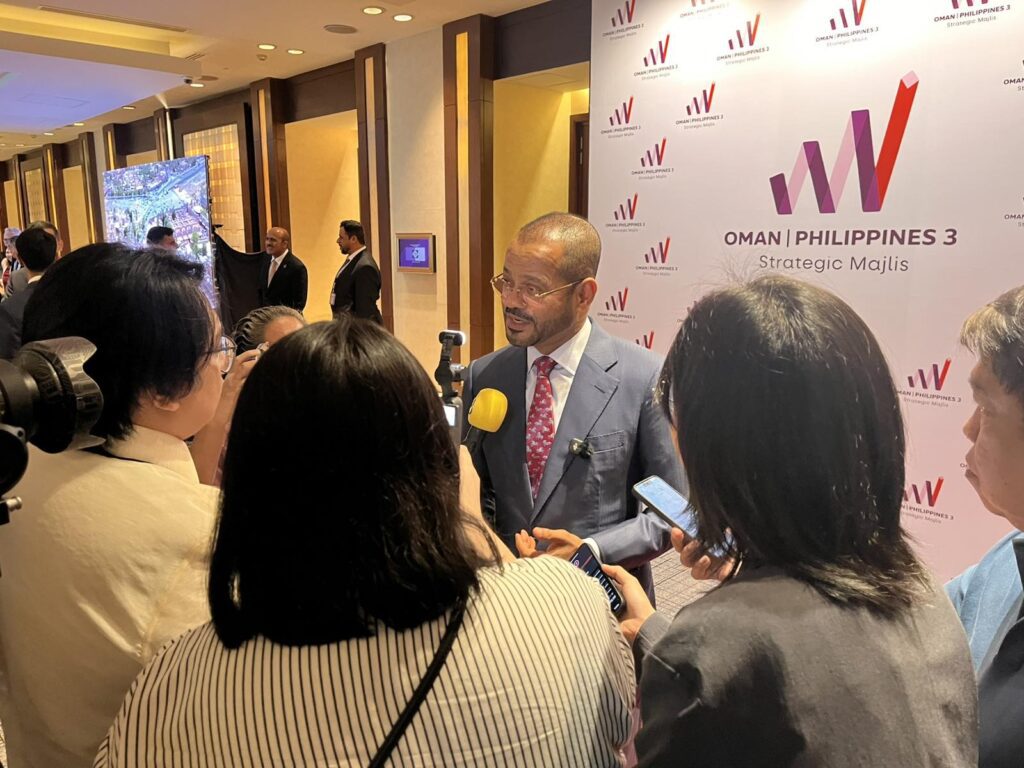
“Our relationship has always been built on trust, confidence, and mutual benefit,” Albusaidi said in a short interview with the media. “From that stems many different avenues for collaboration—in investments, tourism, mining, agriculture, food security, logistics, transportation, aviation, and now even renewable energy.”
The forum, attended by government officials and business leaders from both countries, reflected a growing push to deepen commercial engagement as Oman positions itself as a gateway connecting Southeast Asia to the Gulf, East Africa, the Indian subcontinent, and Central Asia.
Albusaidi said Oman offers investors a stable and efficient platform with access to a market of roughly two billion people across neighboring regions.
“Oman offers a platform that is safe, robust, and efficient,” he said. “Its strategic location allows businesses to reach markets across the Arabian Peninsula, East Africa, the Indian subcontinent, and Central Asia.”
He added that strengthening trade corridors between Southeast Asia and Gulf Cooperation Council (GCC) countries could also improve supply chain resilience amid geopolitical and environmental disruptions.
When asked whether stronger links with Oman could help cushion cross-border disruptions, he said there are always diverse avenues to collaborate that enhance our resilience in the face of unexpected geopolitical and environmental challenges.
Albusaidi identified food security, agriculture, the blue economy, and renewable energy as the sectors offering the most immediate investment opportunities between the two countries.
“The low-hanging fruits are in food security, agriculture, the blue economy, and energy transformation,” he said.
He also pointed to growing opportunities in data centers, information technology, and innovation-driven industries, including the space sector, noting that discussions are increasingly looking beyond traditional industries.
Business leaders attending the forum represented sectors ranging from logistics and mining to technology and space, signaling what Albusaidi described as one of the most successful editions of the Oman–Philippines business forum.
To support greater investment flows, Oman and the Philippines are working toward signing key bilateral agreements in the coming months, including an investment promotion agreement and a treaty to avoid double taxation.
Albusaidi said these frameworks are intended to make cross-border investments easier and encourage long-term business partnerships.
“I don’t see major challenges,” he said. “The know-how is there, the funding is there, and the infrastructure is there. We just need to connect these elements together and facilitate business.”
The two countries are also preparing to hold the fourth Oman–Philippines business forum in Muscat, tentatively scheduled for November, as part of continuing efforts to strengthen private-sector engagement.
Albusaidi also credited Oman’s visa facilitation measures with helping boost travel between the two countries.
“We are open to more tourism traffic and to facilitating business-to-business travel without cumbersome visa processes,” he said, adding that visitor numbers have increased in both directions, including from the Philippines.
Looking ahead, Albusaidi said Oman remains open to pursuing broader economic arrangements—including a possible economic partnership agreement or even a free trade agreement with the Philippines—if they help promote greater investment and trade.
“We are open to all kinds of initiatives that deepen our relationship through agreements that facilitate free trade and offer incentives for investments in both directions,” he said.
He emphasized that opportunities are not limited to Philippine companies investing in Oman, saying it is a two-way process, that there are investment opportunities in the Philippines as well.
Albusaidi also acknowledged the role of the Filipino community in Oman, saying the country’s overseas workers have become an important foundation for expanding economic ties.
“The Filipino community is one of the most robust, successful, and hardworking communities, with very few issues,” he said. “That gives businesses confidence and creates a strong foundation for even greater cooperation.”
As global economic dynamics continue to shift, Albusaidi said both countries have an opportunity to build on their decades-old relationship and move toward a broader strategic economic partnership.
“We need each other,” he said. “That need is becoming more important than ever before as the world continues to change politically, economically, and technologically.”