
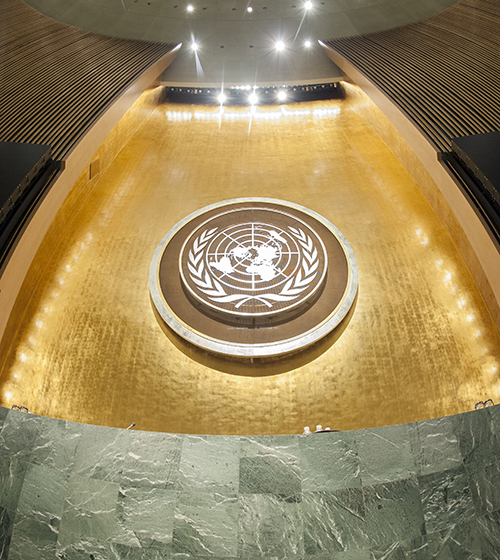
THE Office of the President has announced that President Rodrigo Duterte will participate in the High-Level General Debate of the United Nations General Assembly (UNGA), to be held on September 21 to 27 within 4 a.m. to 6 a.m., Philippine Standard Time.
In a statement, Malacañang said that Duterte will address Philippine positions on global issues of key concern in the 76th session of the international body’s general assembly.
Included in the socio-political and economic matters that the president will discuss are situations involving universal access to COVID-19 vaccines, climate change, human rights, migrant workers and refugees, and international and regional security developments.
The High-Level General Debate will be presided over by the UNGA’s incoming president H.E. Abdulla Shahid of Maldives.
With the theme “Building resilience through hope to recover from COVID-19, rebuild sustainably, respond to the needs of the planet, respect the rights of people, and revitalize the United Nations,” the convention will mainly encompass formidable challenges of different nations amid the pandemic.
The assembly—which serves as the deliberating organ of the UN—will be conducted in a “hybrid format” where delegates are expected to join in-person or virtually in “view of the evolving situation due to the COVID-19 pandemic.”
Duterte has first attended the world’s foremost diplomatic stage in 2020 with the 193-member strong UNGA.
During his first speech in the UNGA, he raised various significant points including the 2016 arbitral decision made against China over the West Philippine Sea dispute and the inclusive access to safe and quality vaccines among rich and poor nations which were lauded both by his Cabinet members and critics.
Duterte, whose war on drugs campaign is under probe by the International Criminal Court (ICC), will continue to present his second address, which further covers human rights despite the Hague-based tribunal’s earlier extensive claim that, ironically, killings during his drug war order turned as a state policy.
(PHOTO CREDIT: un.org)