
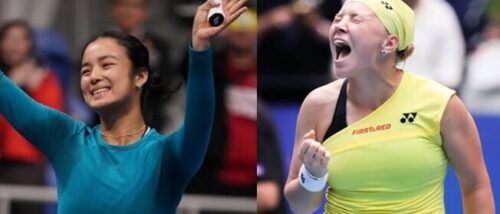
TOKYO, Japan–Seven years, two left-handers, one unfinished story.
Seven years after Alexandra Eala defeated Diana Shnaider, 6-1, 6-3, in a junior tournament in Osaka in 2019, the two rising tennis stars return to Japanese soil this Friday for a high-stakes quarterfinal showdown at the Toray Pan Pacific Open, a WTA 500 event, with a semifinal berth on the line. Their first professional meeting came earlier this year at the Ningbo Open in China, where Shnaider turned the tables with a 7-5, 6-4 victory, setting the stage for another intriguing encounter between the two.
For Eala, the quarterfinal showdown offers something more significant than another chance to defeat a familiar opponent. It presents an opportunity to measure how far she has progressed since their junior tennis days and how quickly she can adapt to a player who defeated her just one week ago.
The tournament’s eighth seed 21-year-old Filipina and the Russian third seed have followed different paths into the upper ranks of women’s tennis, but their careers have intersected at intriguing moments.
Now, Japan provides the setting for another chapter, with Eala seeking to demonstrate that the lessons of Ningbo can translate into a different result in Tokyo.
Unlike a typical rematch, the contest comes with little room for reinvention. Both players are left-handed, reducing the usual advantage that their playing orientation can provide against right-handed opponents.
That similarity could make tactical adjustments especially important. Eala will need to find ways to prevent Shnaider from controlling exchanges while using her own movement, returns and shot placement to disrupt the Russian’s rhythm.
Recent performances suggest the Filipina has the tools to make those adjustments.
Against Australia’s Talia Gibson in Wednesday’s second round, Eala recovered from losing the opening set to secure a commanding 4-6, 6-2, 6-0 victory.
She won the final nine games of the match, turning an initially difficult encounter into a convincing demonstration of endurance and composure.
The victory earned Eala her first quarterfinal appearance since capturing her maiden WTA title in Washington in August.
Afterward, Eala emphasized the importance of maintaining concentration even when opportunities were not immediately converted.
Shnaider, meanwhile, encountered her own difficulties before overcoming Aliaksandra Sasnovich, 6-3, 5-7, 6-3, in two hours and 31 minutes.
The Russian has reached eight quarterfinals this season, reflecting the consistency that has established her among the tour’s leading young players. Eala has also reached eight quarterfinals across competition levels in 2026, including six at WTA Tour level.
Those results add another dimension to Friday’s encounter. Although Shnaider enters with the higher ranking and the advantage of their latest meeting, Eala arrives having demonstrated an ability to recover from setbacks and impose her game over extended stretches. The challenge, however, will be sustaining that level against an opponent who already knows how to beat her.
Their Ningbo encounter was decided in straight sets, but neither set was one-sided. Eala’s task in Tokyo is not necessarily to produce an entirely different game. It is to make better use of the opportunities that separated victory from defeat in China.
The turnaround could depend on small margins: a stronger start, more effective returns on important points, and the ability to dictate rallies before Shnaider settles into her preferred patterns.
Beyond the tactical contest, the match also reflects the changing landscape of women’s tennis, where younger players are increasingly building rivalries while establishing themselves at the sport’s highest levels.
For Philippine tennis, Eala’s presence in another WTA 500 quarterfinal reinforces her growing competitiveness against established international opponents. A victory would send her into the Tokyo semifinals and give her another significant result during the closing stretch of the season.
But the significance of Friday’s contest extends beyond the immediate result.
When Eala and Shnaider met in Osaka in 2019, both were promising juniors with professional careers still ahead of them. Their next encounter came on the international tour, where Shnaider emerged victorious.
Their third meeting, scheduled today at 4 p.m. (Philippine time), offers another test of how quickly that competitive balance can change.
Seven years after their first encounter in Japan, the question is no longer which player has the brighter future. It is which one can make the better adjustments when their paths cross again.