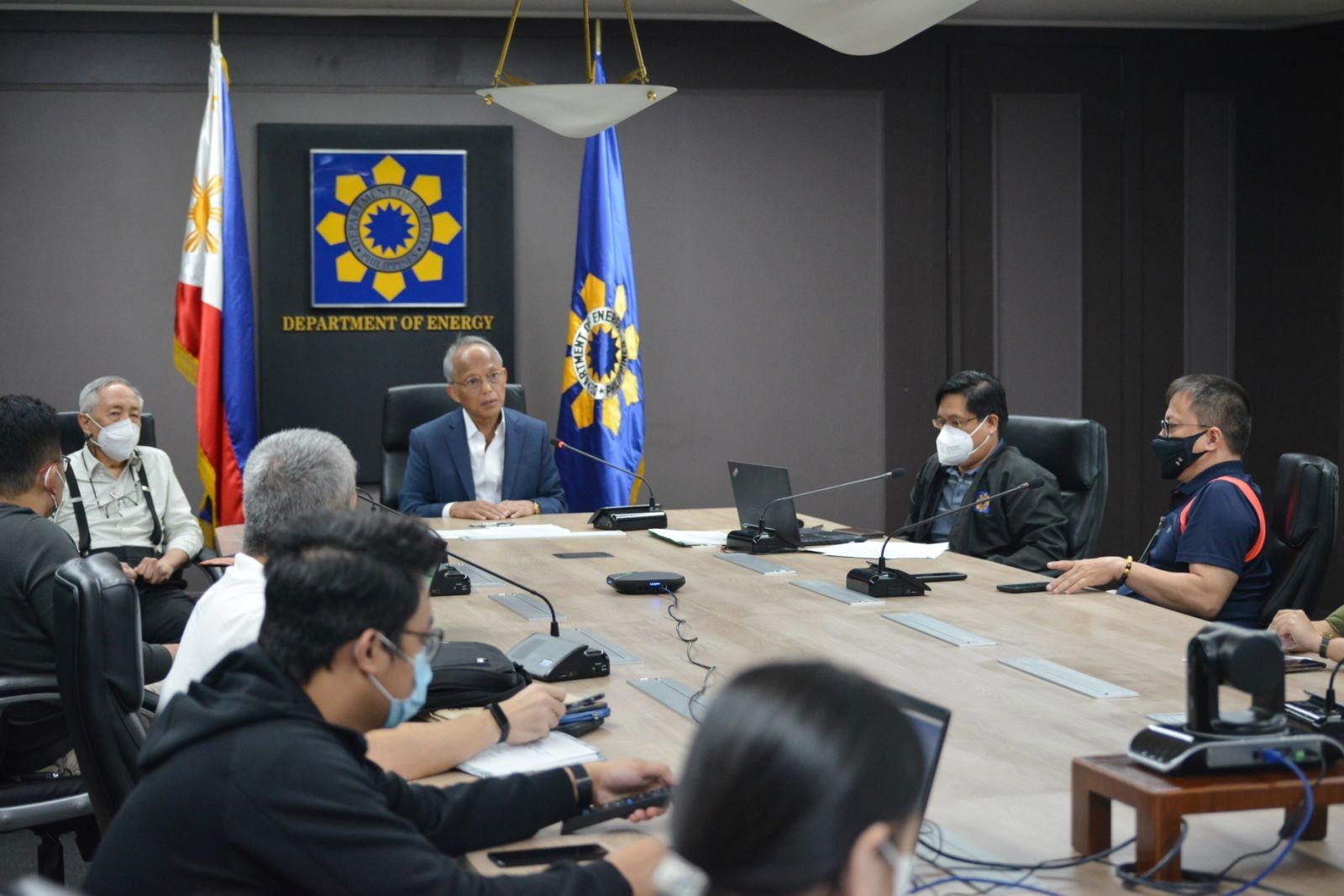
TAGUIG CITY – A meeting was conducted today by the Department of Energy (DOE) together with downstream oil industry players to draft a collective strategy to ensure that there is enough supply of petroleum products as global prices continue to climb amid the Russia-Ukraine standoff.
DOE Secretary Alfonso Cusi said now is the time for the government and the private sector to band together and make things happen. “We are all consumers, and we must exhaust all available options to make things easier for the consuming public. I wanted to meet you so we could discuss our strategies, and of course, to listen to the concerns and suggestions of the industry players on how the DOE could help you during this time.”
Cusi pointed to the strategy of the Land Transportation Franchising and Regulatory Board and its “Pantawid Pasada Program” that seeks to provide fuel subsidies to qualified members of the public transport sector. He said this is part of government initiatives that would help defray fuel costs for the most vulnerable sectors of society.
The program has an allocated budget of P2.5 billion for FY2022.
He also mentioned the unprecedented P500 million program of the Department of Agriculture that would extend fuel discounts to farmers and fisherfolk.
Cusi further emphasized that industry players should strictly comply with the Minimum Inventory Requirement, as well as all relevant quality and quantity standards, all critical components of the country’s energy security.
Executive Order No. 134 provides that oil companies and bulk suppliers need to maintain at least 15 days’ worth of petroleum products’ supply, and a minimum stock equivalent to seven days for liquefied petroleum gas (LPG).
Refiners, on the other hand, must secure a minimum inventory of crude oil and refined petroleum products equivalent to 30 days.
According to the DOE-Oil Industry Management Bureau, inventory data as of 28 February 2022 indicate sufficient supply levels (diesel: 44.5 days’ worth, gasoline: 85.4 days, kerosene: 80.2 days, LPG: 27.7 days, jet fuel: 69.9 days, and fuel oil:44.4 days).
Cusi likewise reiterated his strategy of putting up a Strategic Petroleum Reserve (SPR) to decrease the impact of global supply disruptions.
He also proposed a partnership between the oil companies and the Philippine National Oil Company that would grant the government access to the former’s available storage capacities in order to fast-track the SPR.
For their part, the industry players assured Cusi that they do not foresee any supply issue despite the war in Ukraine, and was likewise reassured that his concerns regarding potential hoarding were “highly improbable” due to the “elasticity of fuel demand and pre-programed product deliveries”.
The industry players also reaffirmed their strong interest to work with the government amid the challenges, and also asked for the DOE’s assistance in increasing public awareness and understanding on the reasons behind the series of recent price spikes.
Officials from the DOE, Philippine Institute of Petroleum, Pilipinas Shell, UniOil, Petron, Chevron Philippines, FilOil, Phoenix Petroleum, SeaOil, Apex Petroleum, Jetti, and Liquigaz were also present during the meeting.
Cusi also thanked the industry players for their support.
(PHOTO CREDIT: DOE Media)