
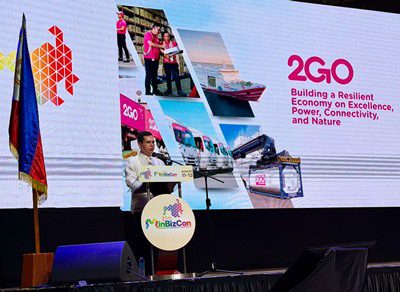
Better connectivity could play a central role in unlocking Mindanao’s economic potential by helping businesses reach wider markets, attracting investments and creating greater opportunities for communities, industry leaders said.
The importance of stronger transport and logistics links was highlighted during the 35th Mindanao Business Conference, held in Cagayan de Oro City under the theme “Accelerating Inclusive Growth through Innovation and Sustainability: Bridging the Gap, Scaling the Future.”
William Howell, chief operating officer and chief financial officer of logistics and transportation company 2GO, said Mindanao should be viewed as a major driver of the Philippine economy rather than a peripheral market.
The region plays a critical role in agriculture and fisheries, energy, manufacturing, mining, exports and tourism. But maximizing these sectors’ potential also depends on how efficiently products, workers, travelers and investments can move within Mindanao and to markets elsewhere in the country.
“Connectivity is not merely about moving goods and passengers. It is about enabling commerce, expanding access, attracting investments, and strengthening communities,” Howell said.
He identified industry, growth engines, connectivity and tourism as key pillars of Mindanao’s economic advantage, with transportation and logistics serving as the link connecting these sectors.
For agricultural producers, reliable logistics can mean faster access to buyers and reduced risks of spoilage. For manufacturers and exporters, efficient transport can help connect production centers with customers and commercial gateways.
The logistics sector is already handling a substantial volume of goods moving through Mindanao. In 2025, 2GO’s sea freight operations transported about 2.5 million metric tons of cargo to, from and within the region.
Its broader forwarding network includes 93 distribution hubs and warehouses nationwide, 18 of them in Mindanao. The company said its Mindanao operations handle about 1.5 million packages, equivalent to roughly 150,000 transactions, each year.
Beyond conventional freight services, logistics providers are increasingly offering specialized solutions such as cold-chain transport for agricultural and food products, project logistics for major developments, e-commerce fulfillment and cross-docking to speed up the movement of goods.
Passenger connectivity is another part of the equation, linking entrepreneurs, workers, tourists and communities to economic opportunities across the country.
2GO Travel operates 36 active passenger routes nationwide, including 18 routes with connections to Mindanao. The network provides 37 weekly voyages linking the region with destinations in Luzon and the Visayas.
The push for stronger connectivity comes as Mindanao seeks to build more resilient and inclusive growth across its diverse industries. Discussions at the business conference covered economic planning, infrastructure, smart industrial development, energy transition, digital infrastructure, trade, climate-smart business, tourism and financing for micro, small and medium enterprises.
The private sector has also been working with government and business groups to identify supply-chain bottlenecks and opportunities. Earlier this year, 2GO, the Mindanao Development Authority and the Davao City Chamber of Commerce and Industry Inc. brought together regional stakeholders to discuss ways to improve logistics and supply-chain connectivity.
For Mindanao, the broader challenge is ensuring that the region’s growing production and investment opportunities are matched by infrastructure and transport networks capable of bringing goods, people and businesses closer to markets.
As the region charts its next phase of economic development, stronger connections could help turn its agricultural, industrial and tourism potential into more widely shared opportunities.