
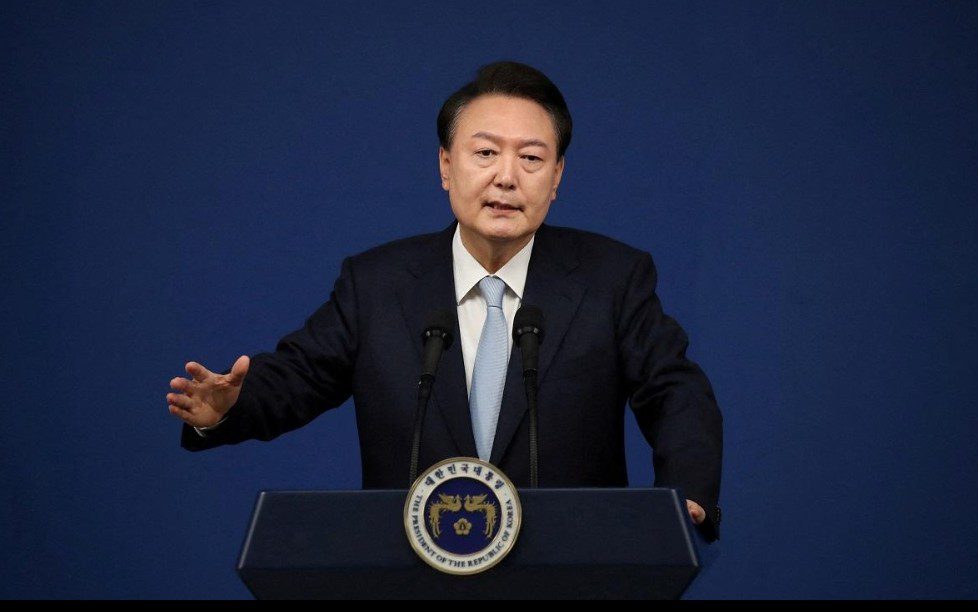
SOUTH Korean lawmakers are calling for the impeachment of President Yoon Suk Yeol after his shocking declaration of martial law late Tuesday, which he reversed just hours later. The unprecedented move has triggered the most severe political crisis in decades for Asia’s fourth-largest economy.
The declaration sparked a standoff with parliament, which swiftly rejected Yoon’s attempt to ban political activities and censor the media. Armed troops stormed the National Assembly in Seoul, escalating tensions. Opposition lawmakers announced plans to propose an impeachment bill on Wednesday, with a vote expected within 72 hours.
“The parliament should immediately suspend the president’s powers and pass the impeachment bill as soon as possible,” said Hwang Un-ha, a member of the opposition coalition.
In the wake of the chaos, Yoon’s chief of staff and senior secretaries offered their resignations, according to a presidential official. Meanwhile, Yoon defended his decision in a televised address, citing threats from North Korea and domestic anti-state forces, though he failed to provide specific evidence.
Parliament Overrules Martial Law
Scenes of chaos unfolded as helmeted troops smashed windows to enter the parliament building, with military helicopters hovering overhead. Aides inside the National Assembly used fire extinguishers to repel the soldiers, while protesters clashed with police outside.
Despite the dramatic show of force, parliament swiftly passed a motion to nullify martial law with unanimous support from 190 lawmakers, including members of Yoon’s own People Power Party. Facing mounting pressure, Yoon rescinded the declaration.
Celebrations erupted outside the National Assembly as protesters chanted, “We won!” and vowed to continue demonstrations. The Korean Confederation of Trade Unions announced plans for a mass rally and threatened a general strike until Yoon resigns.
Economic and International Repercussions
The crisis rattled South Korea’s financial markets. Stocks fell by 2%, and the won hit a two-year low before stabilizing after suspected government intervention. The finance ministry pledged to inject liquidity into markets to prevent further volatility.
Globally, the crisis drew sharp responses. U.S. Secretary of State Antony Blinken welcomed Yoon’s reversal, emphasizing the importance of resolving disputes under the rule of law. Planned defense talks and joint military exercises with the U.S. were postponed, as was a visit by Sweden’s prime minister.
Calls for Resignation
Opposition leaders accused Yoon of treason, demanding his resignation or impeachment. “Even if martial law is lifted, he cannot avoid charges of treason. The nation has seen that he is unfit to govern,” said Democratic Party lawmaker Park Chan-dae.
An impeachment would require a two-thirds majority in the National Assembly and confirmation by South Korea’s Constitutional Court. If successful, Prime Minister Han Duck-soo would serve as interim leader until new elections are held.
Yoon’s Uncertain Future
Yoon, a former prosecutor who narrowly won the 2022 presidential election, has struggled with low approval ratings and mounting criticism. His People Power Party suffered heavy losses in the April parliamentary elections, leaving him vulnerable to opposition challenges.
While South Korea narrowly averted a deeper constitutional crisis, the fallout from Yoon’s actions is far from over. As protests grow and impeachment looms, the country faces a test of its democratic resilience.
“South Korea dodged a bullet, but President Yoon may have shot himself in the foot,” remarked Danny Russel of the Asia Society Policy Institute. (Reuters)