
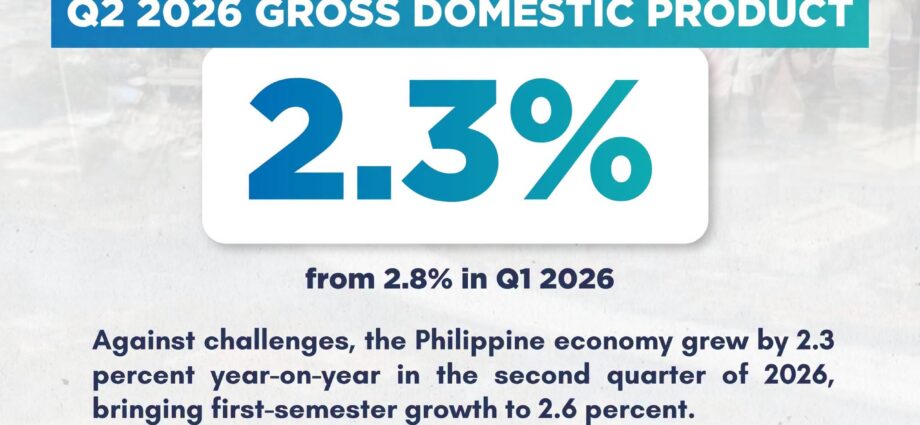
The Philippine economy expanded by 2.3 percent in the second quarter of 2026, bringing first-semester growth to 2.6 percent, as global uncertainties and domestic challenges continued to weigh on economic activity. Despite the slower pace, the government expressed confidence that recent developments point to the beginning of a gradual recovery.
Department of Economy, Planning, and Development (DEPDev) Secretary Arsenio Balisacan said weaker domestic demand largely reflected a continued decline in total investments, driven by reduced public construction spending. Household consumption also softened as rising inflation, employment losses, and lower remittances linked to the conflict in the Middle East dampened consumer spending.
Government spending, however, provided support to the economy as social assistance programs were expanded to protect vulnerable families and affected sectors from rising costs.
Several sectors also delivered encouraging results during the quarter. Agriculture rebounded on the back of favorable weather conditions, while manufacturing posted stronger growth. Exports of goods and services likewise improved, with robust global demand for artificial intelligence-related products boosting semiconductor shipments and helping net exports recover.
Although the latest growth figures fell below expectations, Balisacan said recent economic indicators suggest that conditions are beginning to improve.
He noted that the Department of Budget and Management has started releasing mobilization funds for infrastructure projects, enabling the Department of Public Works and Highways to award construction contracts beginning in June and July. This is expected to accelerate public construction and infrastructure spending during the third quarter and beyond.
Business sentiment has also become more optimistic. Results of the Bangko Sentral ng Pilipinas’ June Business Expectations Survey showed improved confidence among firms for the months ahead, while the S&P Global Philippines Purchasing Managers’ Index recorded stronger manufacturing activity at the start of the third quarter.
To achieve the government’s full-year economic growth target of 3.5 to 4.5 percent, the country will need to expand by at least 4.4 percent in the second half of the year. Balisacan acknowledged that the target will require sustained efforts but said it remains attainable through coordinated action across government.
Among the administration’s priorities is the accelerated implementation of major infrastructure projects, supported by stricter monitoring, accountability measures, and governance reforms aimed at improving transparency, streamlining business processes, and restoring investor confidence.
The government is also pushing for the passage of 33 priority measures endorsed by the Legislative-Executive Development Advisory Council (LEDAC). These proposed laws seek to strengthen governance, combat corruption, enhance energy security, improve economic resilience, and expand opportunities for Filipinos.
Protecting consumers from rising prices remains another key priority. Under the Unified Package for Livelihoods, Industry, Food, and Transport (UPLIFT) Framework, targeted cash assistance, fuel subsidies, and fertilizer support will continue for vulnerable households and affected sectors. The government also plans to improve digital distribution systems and strengthen coordination with local governments to ensure assistance reaches intended beneficiaries efficiently.
To stabilize food and energy supplies, authorities will expand support for farmers and fisherfolk, maintain strategic food reserves, fully implement the El Niño Strategic National Action Plan, and continue promoting renewable energy development while modernizing the country’s power grid.
The administration also intends to sustain export growth by pursuing trade agreements with the European Union, Chile, and Canada, while seeking reconsideration of the United States’ 12.5-percent tariffs on selected Philippine exports. Efforts to modernize trade systems and improve the efficiency of ports, transport, and energy services are likewise expected to enhance the country’s competitiveness.
Recognizing the growing global demand for AI-related technologies, the government plans to strengthen higher-value manufacturing and services, expand workforce upskilling and reskilling programs, and support the growth of outsourcing firms through the resumption of new Philippine Economic Zone Authority accreditations in Metro Manila.
Despite the improving outlook, Balisacan cautioned that risks remain, including the ongoing conflict in the Middle East, elevated oil prices, tighter financial conditions, and weather-related threats such as El Niño and typhoons.
Looking ahead, the government remains focused on accelerating investments, protecting household purchasing power, strengthening domestic production, and improving the competitiveness of Filipino businesses and workers.
While challenges persist, Balisacan said the latest indicators suggest that the foundations of an economic recovery are beginning to take shape, with the goal of translating renewed momentum into more jobs, higher incomes, and better opportunities for Filipinos.
(PHOTO CREDIT: DEPDev Facebook page)