
Printers may not be the most talked-about technology in the workplace, but they remain closely tied to how businesses get work done. Contracts still need to be printed, documents need to be scanned, and sensitive information needs to move between employees, offices and digital platforms.
As workplaces become more connected and increasingly hybrid, however, the traditional office printer is taking on a bigger role. Multifunction devices (MFDs) are evolving into connected workplace tools that can support document workflows, strengthen security and help businesses reduce operational disruptions.
Canon Philippines’ imageFORCE portfolio reflects this shift, with features designed to address some of the everyday challenges faced by both large enterprises and small and medium-sized enterprises (SMEs).
One of the biggest concerns for any organization is downtime. A malfunctioning device might seem like a minor inconvenience, but when teams depend on it for high-volume printing and scanning, even a small problem can interrupt workflows.
Canon’s imageFORCE devices use AI-assisted maintenance to help detect potential issues early. The idea is straightforward: identify problems before they turn into bigger disruptions. For enterprises, this can be particularly useful in environments where multiple departments rely on shared devices. For SMEs with fewer IT resources, anything that can reduce unexpected interruptions can make a noticeable difference to day-to-day operations.
The devices also use Canon’s D² Exposure Technology to deliver sharp and consistent document output. While print quality may sound basic, it matters when businesses are producing customer documents, reports, presentations, contracts and other materials where clarity and consistency are important.
Security is another area where the role of MFDs has changed. Once viewed primarily as office peripherals, connected printers and scanners now form part of an organization’s wider IT environment. That means they also need to be protected against unauthorized access and potential security risks.
The imageFORCE portfolio incorporates security features designed to protect devices, networks and sensitive business information. Secure printing and scanning can also help organizations have greater control over who can access confidential documents.
This can be especially relevant for enterprises handling financial, employee or customer information across multiple departments and locations. SMEs can benefit as well, particularly as smaller businesses increasingly adopt cloud services and digital workflows but may not have large cybersecurity teams or extensive IT infrastructure.
Connectivity is another important piece of the equation. Employees today may be working from an office, at home or from another location, while documents can exist simultaneously in paper and digital formats.
Canon’s imageFORCE devices are designed to make it easier to print, scan and access documents across cloud platforms while maintaining security. For businesses with hybrid teams, this can help bridge the gap between physical paperwork and digital collaboration instead of forcing employees to work around disconnected systems.
There is also a growing expectation for workplace technology to consume fewer resources. The imageFORCE range incorporates energy-saving technologies and uses up to 30% recycled plastics, giving businesses another consideration when evaluating their office equipment.
For larger companies with formal environmental targets, these features can complement broader sustainability programs. For SMEs, energy efficiency and the use of recycled materials can provide a practical way to factor environmental considerations into technology purchases without requiring a major overhaul of their operations.
What stands out about the imageFORCE portfolio is how much the modern MFD has moved beyond simply printing pages. Its role increasingly extends into document management, security, connectivity and workplace productivity.
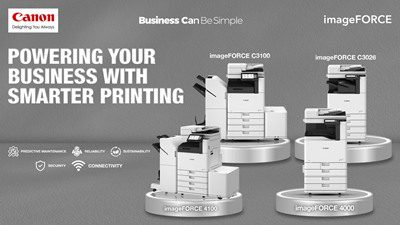
Canon now has imageFORCE models spanning different business requirements, including the C3100, C3026, 4100 and 4000 series. Rather than being relevant only to large corporate environments, the broader portfolio is aimed at making these capabilities accessible to organizations of different sizes.
That approach also builds on Canon’s established position in the A3 multifunction device market. Keypoint Intelligence recently named Canon the recipient of its BLI 2026 A3 Line of the Year Award for the 13th consecutive year, recognizing the performance and ease of use of its A3 MFD portfolio.
For businesses, though, the real value of these devices is less about the hardware itself and more about what happens around it. When documents can move securely, devices can identify problems before they cause downtime, and employees can connect physical and digital workflows more easily, seemingly routine office equipment can have a much bigger impact on productivity.
For enterprises and SMEs trying to keep up with faster, more distributed ways of working, that may be the more important evolution: the office MFD is no longer just a machine that prints documents. It is becoming another connected piece of the technology infrastructure that keeps business moving.