
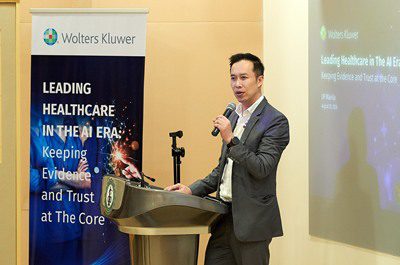
AS artificial intelligence (AI) moves deeper into healthcare, Philippine medical and academic leaders are emphasizing a fundamental requirement for its adoption: clinicians must be able to trust, trace and verify the information behind AI-generated answers.
The issue took center stage at a recent Manila workshop hosted by information solutions, software and services provider Wolters Kluwer, where healthcare and education leaders discussed how AI could support medical education, clinical learning and healthcare delivery without undermining professional judgment.
The discussion comes as the Philippines continues to grapple with a shortage and uneven distribution of healthcare workers. The country has about four doctors for every 10,000 people, which is below the World Health Organization benchmark of 10, while only two of the country’s 17 regions meet the recommended doctor-to-population standard.
The EDCOM II Report 2026 has also identified an estimated nationwide shortage of around 290,000 healthcare professionals.
These gaps can translate into heavier workloads for clinicians, longer waiting times and unequal access to medical services, particularly between urban centers and provincial communities. Against this backdrop, AI is increasingly being considered as a potential way to expand access to medical information and support healthcare professionals.
But participants at the workshop stressed that greater access to information is useful only when healthcare workers can determine whether that information is reliable.
That makes transparency a critical issue in healthcare AI.
Unlike applications where an incorrect AI-generated answer may simply be inconvenient, an inaccurate medical response can influence a diagnosis, treatment decision or clinical recommendation. Healthcare professionals therefore need to know where an AI system’s information comes from, how current it is and whether the underlying evidence can be independently reviewed.
Wolters Kluwer used the workshop to present UpToDate Expert AI, a generative AI experience built on evidence-based medical content from UpToDate. The tool allows healthcare professionals to ask questions using natural language and review responses alongside the supporting medical content.
Its approach is designed to make the information behind AI responses visible, allowing users to assess the underlying evidence rather than treating the AI output as an unquestionable answer.
The company emphasized that the technology is intended to support clinical learning and reasoning, rather than replace the judgment of healthcare professionals.
That distinction could become increasingly important as healthcare institutions experiment with generative AI.
Several Philippine organizations, including The Medical City, Jose R. Reyes Memorial Medical Center and Makati Medical Center, have publicly announced their evaluation or use of evidence-grounded generative AI. More broadly, more than 45 institutions in the country, including hospitals, medical schools and the Department of Health use Wolters Kluwer clinical solutions to support medical education and evidence-based practice.
Hong Nguyễn, regional director for APAC at Wolters Kluwer, said the usefulness of AI in healthcare ultimately depends on the quality and reliability of the information behind its responses.
“AI has significant potential to support healthcare professionals, but its value ultimately depends on the quality and reliability of the information behind its responses. A key challenge with generative AI in healthcare is ensuring that clinicians can understand where information comes from, whether it reflects current evidence, and whether it can be independently evaluated.“
He adds that technology should be grounded in the best available evidence and used alongside the clinician’s expertise, experience, and professional judgment. “Healthcare professionals must continue to critically assess information and understand the sources behind it. We believe AI can help make trusted knowledge more accessible, but it should strengthen, not replace, clinical judgment.“