
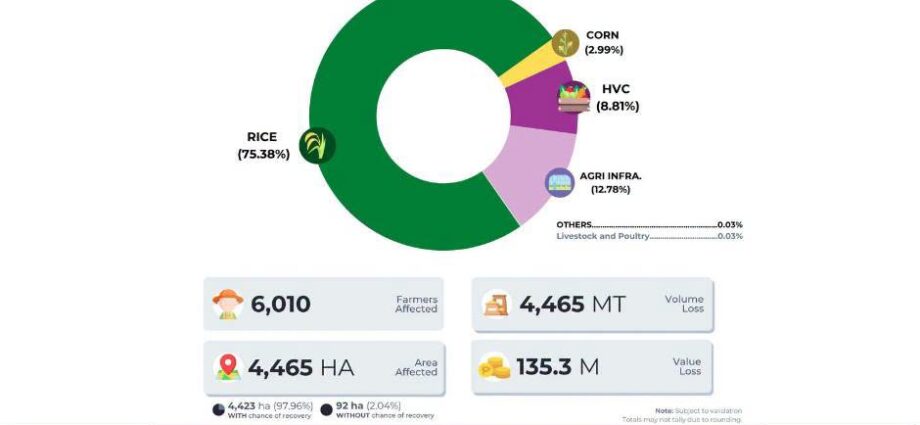
Agricultural damage and losses from Tropical Cyclones Luis and Maymay, along with the enhanced southwest monsoon, have reached an estimated P135.3 million, with thousands of farmers affected across five regions, the Department of Agriculture (DA) said.
The latest assessment covers the Ilocos Region, Central Luzon, CALABARZON, MIMAROPA and Western Visayas. At least 6,010 farmers have been affected, while about 4,516 hectares of farmland sustained damage. Production losses have been placed at roughly 4,465 metric tons.
Rice, corn, high-value crops and livestock were among the agricultural commodities hit by the weather disturbances. The DA also reported damage to farm infrastructure, machinery and equipment.
The figures remain preliminary, however. Field teams are continuing to assess and validate reports as weather and ground conditions improve, meaning the estimated damage could rise as more affected farms are reached.
Agriculture Secretary Francisco Tiu Laurel Jr. has directed DA offices to accelerate assistance to affected farmers, particularly insurance claims and access to credit.
“We need our people on the ground to move quickly so affected farmers can get the assistance they need, especially insurance claims and credit support,” Tiu Laurel said, stressing that faster processing would help farmers return to production sooner.
The DA has prepared P106.5 million worth of agricultural inputs, including rice, corn and vegetable seeds, for distribution through its regional field offices.
Affected farmers may also seek financing through the Agricultural Credit Policy Council’s Survival and Recovery Loan Program. The facility provides loans of up to P25,000, with zero interest and a repayment period of up to three years.
For insured producers, the Philippine Crop Insurance Corp. will provide indemnification, with the DA coordinating insurance and credit assistance through the PCIC and the Agricultural Credit Policy Council.
Regional DA offices are also coordinating with disaster risk reduction councils, local government units and other government agencies while keeping watch on agricultural prices and commodity flows.
The response comes as the government seeks to prevent crop losses from developing into a wider supply problem. Reduced farm production can cut household incomes in rural communities while also limiting the volume of food reaching markets, potentially putting additional pressure on prices.
For farmers preparing for the next planting cycle, the timing of assistance could be crucial. Seeds and financing delivered too late may not help producers take advantage of available planting windows.
The DA is therefore pushing field validation and the delivery of assistance at the same time rather than waiting for a final assessment before acting.
With damage assessments still ongoing, the P135.3-million estimate represents an initial measure of the agricultural toll from the weather disturbances and should not yet be considered the final cost.