THE country’s Chief Executive abandoned the plan to end the Visiting Forces Agreement (VFA) with the United States.
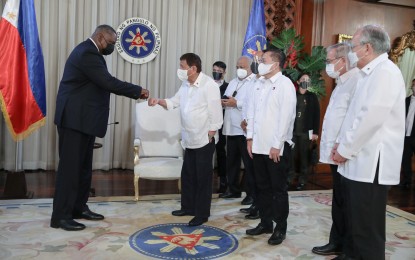
This came after President Rodrigo Duterte’s meeting with US Defense Secretary Lloyd Austin, who is in the Philippines for a two-day visit from July 29 to 30.
“The VFA is in full force again after Secretary Austin’s meeting with President Rodrigo Duterte,” Defense Secretary Delfin Lorenzana told the media in a press briefing held at Camp Aguinaldo in Quezon City.
Duterte, who has consistently been threatening in the form of formal notice the abrogation of the VFA, thus ended more than a year of uncertainty over the fate of the deal, which provides the legal framework for the presence of US troops in the Philippines for war games and other joint activities.
The move was believed to be out of Duterte’s protest over two previous incidents — the US cancellation of the visa of former Philippine National Police chief, now Senator Ronald Dela Rosa, for the bloody anti-drugs campaign in the early years of his presidency and that of the US Senate’s adoption of a resolution that seeks Global Magnitsky Act sanctions against Philippine officials involved in extrajudicial killings and the detention of his staunch critic, Senator Leila de Lima.
Duterte suspended the process of terminating the deal three times – first in June 2020, again in November, after Joseph Biden’s victory as US president, and a third time in June 2021, to make way for further negotiations.
However, Cabinet members defended Duterte’s decision to freeze the termination process, saying that the move was triggered by the COVID-19 pandemic and rising tensions in the South China Sea, of which the West Philippine Sea is a part.
“We thank President Duterte for fully restoring the VFA,” Austin said.
On Friday, Lorenzana said he was not privy to the details behind Duterte’s latest decision. “I don’t really know what’s behind the President’s decision,” he said.
“One thing is clear, the DFA (Department of Foreign Affairs) and Philippine Ambassador (to the US Jose Manuel Romualdez) have been working for this,” Lorenzana added.
Interestingly, while the Philippine and US officials were in a series of meetings in February on changing terms of the agreement, Duterte said the US “must pay” in order to keep the VFA. This came at the heels of an earlier ultimatum that the Western power must give the Philippines COVID-19 vaccines if it wanted American soldiers in the country.
Philippine Ambassador to the US Jose Manuel “Babes” Romualdez said in early June that concluded negotiations had “improved” the key deal between the two countries.
Philippine and US officials had also long recognized that the VFA is necessary for the two countries’ Mutual Defense Treaty (MDT), which sees both countries commit to defend one another in case of an attack. The two countries will mark the 70th year of the MDT on August 30.
The Philippines counts on its military alliance with the US to ward off more aggression from China, especially given the Asian giant’s attempts to claim Philippine waters. The deal is also viewed as a deterrent to China’s expansionist claims as the Philippine military remains one of the weakest in the region.
Duterte’s decision to keep the VFA also comes after Biden announced that the Philippines would be among the first countries to benefit from the US surplus of COVID-19 vaccines. In July, it received some 3.2 million Johnson & Johnson doses.
Earlier, US State Secretary Antony Blinken and Austin reassured the Philippines that the MDT, which encompasses the VFA, would cover the South China Sea, including the West Philippine Sea. Past US officials have given the same assurance.
(PHOTO CREDIT: pna.gov.ph)