
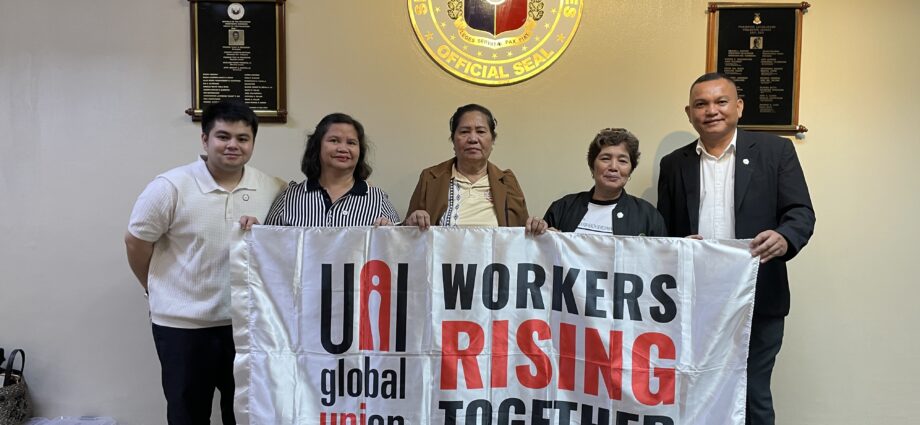
Labor groups renewed calls for the passage of a Magna Carta for Barangay Health Workers (BHWs) after the Senate Committee on Health and Demography conducted a public hearing on the long-pending measure on December 9, describing the development as a crucial first step toward improving the welfare of tens of thousands of BHWs nationwide.
In a statement, the UNI Global Union–Philippine Liaison Council (UNI-PLC) and the National Barangay Health Workers Confederation of the Philippines (NBHWCP) welcomed the hearing, saying it signaled renewed attention to the decades-old demand to grant BHWs standard benefits, job security, and protection under the law.
Barangay health workers serve as frontline health providers in communities, particularly in far-flung and underserved areas, acting as the link between residents and the formal health system. Their duties include health education, disease surveillance, assistance in immunization programs, maternal and child care, and disaster response.
Despite their role, NBHWCP President Khonan Cerial said BHWs remain among the least protected and least compensated workers in the health sector.
“For decades, they have worked without standard benefits, job security, or safeguards against risks and political displacement, despite their immense contribution to public health,” Cerial said during the hearing. He stressed that BHWs should be recognized not merely as volunteers but as workers and essential partners in the country’s public health system.
Cerial presented the results of the 2025 Working Conditions of Barangay Health Workers Survey, jointly conducted by UNI-PLC and NBHWCP. The survey covered 6,409 BHWs across all 17 regions, making it the largest nationwide assessment of BHW working conditions to date.
According to the survey, 89.37 percent of respondents said their income is insufficient to meet their family’s basic needs. Many BHWs continue to rely on honoraria rather than regular wages, with some in remote areas reportedly receiving as little as ₱50 to ₱100 a month.
On workplace safety, 33.5 percent of respondents said their work environment is sometimes unsafe, while 7.46 percent described it as unsafe. Risks cited include fieldwork, home visits, disaster response, and working in under-resourced health stations, conditions that expose BHWs—most of whom are women—to hazards without adequate protection or insurance.
The survey also revealed cases of abuse and harassment, with 22.56 percent of BHWs reporting personal experiences of verbal or non-verbal harassment, bullying, or violence at work. Another 17.35 percent said they knew colleagues who had suffered similar experiences.
Job insecurity likewise emerged as a major concern. Nearly 48 percent of respondents said they knew someone who was terminated after elections, while 10.17 percent said they personally lost their work following local polls.
“This shows how vulnerable BHWs are to changes in local political leadership,” Cerial said, warning that the lack of security of tenure undermines both workers’ dignity and the continuity of health services, especially with the 2026 barangay elections approaching.
UNI-PLC President Roland De La Cruz said strengthening protections for BHWs is essential to achieving universal health care.
“Without fair compensation, security of tenure, proper training, and safe working conditions for barangay health workers, the goals of Universal Health Care will remain out of reach,” he said.
Myrna Gaite, president of the BHW Federation of the National Capital Region, expressed disappointment that the Magna Carta is no longer listed as a priority measure under the Legislative-Executive Development Advisory Council (LEDAC) in the 20th Congress, despite previously being prioritized.
Still, Gaite said BHWs remain hopeful that the current Congress will finally pass the measure.
Rajendra Acharya, regional secretary of UNI Asia and the Pacific, said the international labor community continues to monitor developments in the Philippines, urging the government to fulfill its commitment to community health workers.
“The passage of the Magna Carta for Barangay Health Workers is long overdue,” Acharya said, adding that global labor groups will continue to stand in solidarity with Filipino BHWs until their rights and protections are enshrined in law.
The groups stressed that every year of delay prolongs what they described as injustice for barangay health workers, calling on lawmakers to act swiftly for the sake of workers, communities, and the future of public health in the country.