
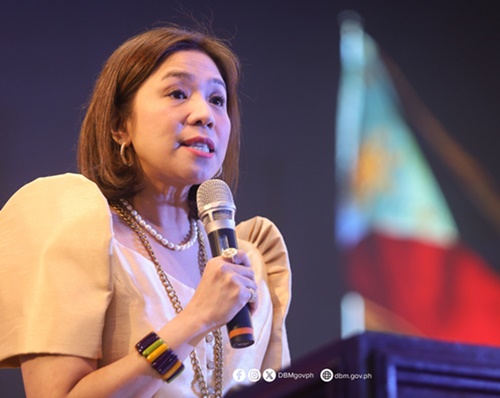
NEW YORK CITY, USA—The head of the Philippine delegation to the 68th annual Commission on the Status of Women (CSW68) emphasized that women play a critical role with regard to global efforts in promoting peace and security.
This was the message put forth by Philippine delegation head to the CSW68, Department of Budget and Management (DBM) Secretary Amenah Pangandaman, when she addressed the various heads of delegations present during the confab, which was held at the United Nations (UN) Headquarters in New York City, USA.
Pangandaman, who hails from Marawi in Mindanao, highlighted the challenges faced by women in her hometown, particularly with regard to access to education and healthcare, which she said continues to be an uphill battle. As the only Filipina Muslim in the Cabinet and the sole female member of the Philippine Economic Team, the secretary said she stands as a beacon of hope for all Filipino women.
“I am deeply honored to address you tonight as Head of the Philippine Delegation. I am from a small city called Marawi in Mindanao where girls had difficulty accessing education, and women lacked access to health care, jobs, and other opportunities. So while I also proudly stand before you today as the only Filipina Muslim in the Cabinet and the only female member of the Philippine Economic Team, I also stand here representing all the women in the Philippines, and the world, whose rights we must protect and promote,” Secretary Pangandaman declared, echoing her commitment to gender equality.
According to the Pangandaman, the event’s theme, “Accelerating the achievement of gender equality and the empowerment of all women and girls by addressing poverty and strengthening institutions with a gender perspective,” highlights how poverty among women continues to be a barrier to gender equality, and how stronger institutions and financing with a gendered perspective can address this.
“This thematic focus aligns well with the Philippines’ implementation of gender mainstreaming and gender-responsive budgeting, as mandated in national laws such as Republic Act 9710 or the Magna Carta of Women, as well as our national strategies, including the Gender Equality and Women’s Empowerment Plan for 2019-2025,” Pangandaman said.
She likewise highlighted the high priority that the Philippines places on the full, equal and meaningful participation of women, inclusivity, respect for human rights, and innovation, through key programs that strengthen institutions and financing for women.
Among these programs include the “Women’s Budget” or the Gender and Development Budget in the General Appropriations Act in 1995, which directs all government agencies to allocate a minimum of five percent of their total annual budgets for gender programs, projects, and activities.
She also mentioned, as Chair of the Philippine Open Government Partnership (PH-OGP), that the Philippines, being one of the eight founding members of the Open Government Partnership, remains deeply committed to transparency, accountability, inclusivity, and civic participation.
“We have just completed our 6th National Action Plan which seeks to improve the responsiveness of our public institutions to the needs of our citizens through public participation and achieve transparency in the use of government resources,” she said.
“We are also working hand in hand with civil society to achieve gender equality and women empowerment. Most recently, we have broadened the Philippine OGP Steering Committee Membership to include a seat for a women’s sector representative to ensure the integration of the perspectives and voices of women in open government initiatives. And even better, she is now my Co-Chair for Civil Society,” the DBM chief added.
She likewise announced that the Philippines will host the International Conference on Women, Peace, and Security in Manila in October of this year. Pangandaman pointed out that the conference will serve as an international stocktaking for the implementation of the global Women, Peace, and Security Agenda and highlight the power of inter-regional networks for sharing experiences, expertise, and best practices in response to challenges to women’s meaningful engagement in peacebuilding.
“By empowering women, we lay the groundwork for a more comprehensive and sustainable peace,” Pangandaman pointed out.
In numerous events, the DBM Secretary stated that no less than President Ferdinand Marcos Jr. steadfastly champions the full and meaningful participation of women in peace and security.
“As a daughter of Mindanao and Co-Chair of the Intergovernmental Relations Body (IGRB), representing the National Government in continuous dialogue with the ministers of the Bangsamoro Autonomous Region in Muslim Mindanao (BARMM), the participation of women in peace and security efforts, especially in Mindanao, means a lot to me,” Pangandaman said.
“As we work hard to ensure lasting peace and economic development in BARMM, it is worthwhile to look back and note that the peace efforts—at the height of the conflict ten years ago—achieved success because of the participation of women. In fact, our government negotiating team was led by a woman, Professor Miriam Coronel-Ferrer,” Sec. Mina added.
She ended by saying that the gathering sends a powerful signal about their profound dedication to women.
“We invite all member states and stakeholders to participate in constructive dialogue and foster collaboration for synergy and impact. Our goal is to emerge with agreed conclusions and concrete actions that will propel us forward in achieving gender equality and empowering women and girls across the world,” the Budget Secretary concluded.