
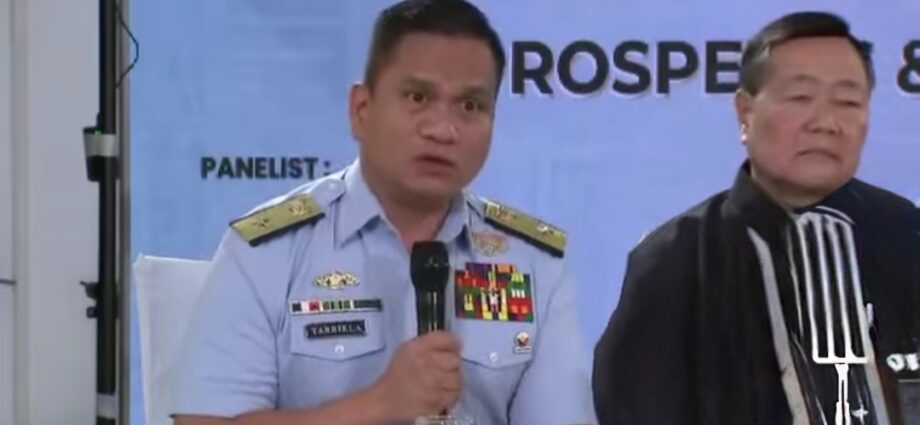
Philippine Coast Guard (PCG) spokesperson for the West Philippine Sea, Commodore Jay Tarriela, has warned that pro-China vloggers are actively spreading disinformation to distort the realities of the West Philippine Sea and mislead the Filipino public.
Speaking before the House Tri-Committee, Tarriela underscored the urgent need to hold online influencers accountable for spreading false narratives that weaken national unity and serve foreign interests.
“I was genuinely pleased to learn about the House of Representatives’ decision to hold a public hearing addressing fake news, disinformation, and misinformation on social media. I believe this presents an opportunity for us to finally establish legislation that holds trolls, influencers, and bloggers accountable for their online content,” Tarriela said.
Disinformation: A Threat to Philippine Sovereignty
Tarriela identified disinformation as the second biggest challenge to the government’s efforts in the West Philippine Sea, next only to China’s direct aggression.
“Apart from China’s bullying, unlawful activities, and aggressive actions, one of the greatest challenges facing the Philippine government in the West Philippine Sea is the spread of fake news and disinformation. These false narratives obscure the truth, leading to confusion and division among our people,” he said.
He explained that during the previous administration, a false sense of security was created, misleading the public into believing that the situation in the West Philippine Sea was under control and that China had eased its aggressive actions.
“The limited reporting of these incidents, combined with the narrative that the former president’s diplomatic efforts had successfully convinced Xi Jinping to allow our fishermen to operate freely, contributed to this false sense of security,” he noted.
Tarriela stressed that for President Ferdinand Marcos Jr. to fulfill his commitment to defending Philippine sovereignty, the public must be made aware of the real situation in the West Philippine Sea.
“For President Marcos to deliver on his promise of not surrendering a square inch of our territory to any foreign power, he must unite the Filipino people. And the only way to do this is to awaken their sense of patriotism,” he said.
How Pro-China Vloggers Manipulate Public Opinion
Tarriela pointed out that pro-China vloggers systematically distort the truth to weaken the country’s position on the West Philippine Sea issue. Their disinformation strategies follow a pattern of five key arguments:
Challenging the Philippines’ Legal Standing – Undermining the 2016 arbitral ruling and falsely asserting that China’s 10-dash line has historical legitimacy.
Twisting the Narrative on Maritime Incidents – Echoing China’s claims that confrontations at sea were provoked by the Philippines, including vessel collisions.
Accusing the Philippines of Being a U.S. Puppet – Framing transparency efforts as dictated by the United States and coordinated by foreign actors.
Spreading a Defeatist Mentality – Claiming that the Philippines is powerless against China and that asserting its rights will only lead to war.
Blaming the Marcos Administration for Tensions – Suggesting that tensions only escalated under the current government while ignoring years of Chinese expansionism.
“These tactics are designed to divide the public, sow doubt, and weaken national resolve in defending our maritime rights,” Tarriela said.
Beyond spreading false narratives, pro-China vloggers also engage in personal attacks against individuals who challenge China’s aggression.
Personal Attacks: A Disinformation Strategy
Tarriela revealed that he himself had become a target of pro-China disinformation campaigns aimed at discrediting him through fabricated allegations:
Highlighting his past dismissal as a Philippine Military Academy cadet to attack his credibility.
Accusing him of being a CIA recruit and a pro-U.S. operative working against China.
Spreading false claims that he received a $4 million talent fee.
Fabricating a story that he visited Speaker Martin Romualdez’s residence to receive three black bags.
“While these lies are absurd, they are not only frustrating but also deeply unfair to my family,” he said.
Tarriela’s experience highlights how pro-China vloggers systematically attack individuals who speak out against Chinese aggression, attempting to silence and discredit them.
Growing Public Awareness Against Disinformation
Despite these disinformation efforts, Tarriela noted that public awareness of the West Philippine Sea issue has significantly improved. Surveys indicate overwhelming support for the government’s efforts to defend the country’s maritime rights.
“In the past two years, we have successfully raised awareness. A recent OCTA Research survey found that 84% of Filipinos support the government’s efforts to defend the West Philippine Sea,” he said.
He also pointed out that seven out of ten Filipinos are unlikely to support pro-China candidates in the 2025 midterm elections, demonstrating that efforts to counter disinformation have been effective.
However, Tarriela warned that as public awareness grows, pro-China vloggers will likely intensify their efforts to manipulate online narratives and influence national policies.
Strengthening Defenses Against Disinformation
With social media platforms serving as the primary battleground for these disinformation campaigns, Tarriela called for stronger measures to regulate online content and prevent foreign-influenced narratives from distorting national security issues.
As the Philippines continues to assert its territorial rights, pro-China vloggers remain a key weapon in Beijing’s information warfare.
Through legislation and public vigilance, Tarriela believes the country can counter these deceptive narratives and defend the truth.
“I am committed to my role in exposing Chinese aggression and raising awareness among the Filipino people so that we can unite as one nation with a renewed sense of patriotism. My efforts are not motivated by U.S. interests or political gain; my dedication is for the future generations of Filipinos,” he said.