
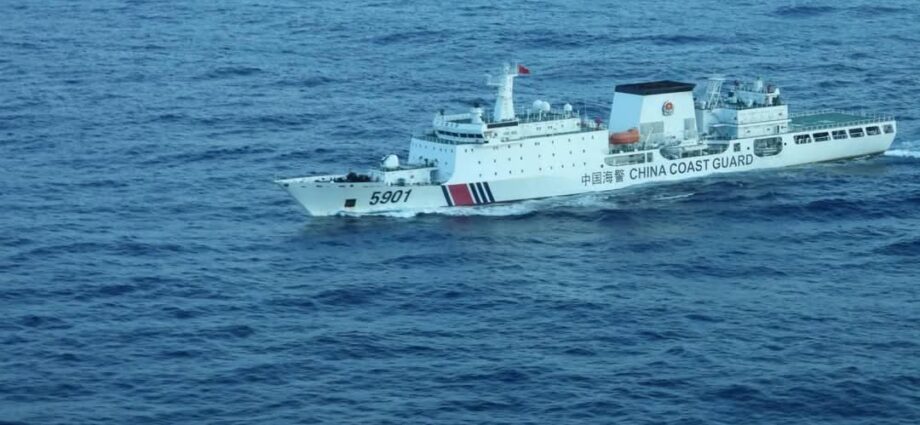
THE Philippine Coast Guard (PCG) deployed a patrol ship and two aircraft to monitor China’s largest coast guard vessel, the 12,000-ton “Monster” (China Coast Guard Vessel 5901), after it was detected 100 kilometers (54 nautical miles) off the coast of Zambales province on Saturday.
Spotted using Canada’s Dark Vessel Detection system, the vessel was reported by Commodore Jay Tarriela, PCG spokesperson for the West Philippine Sea. In response, the PCG sent the BRP Cabra (MRRV-4409), along with a helicopter and Caravan aircraft, to verify the presence of the Chinese ship and assert the Philippines’ sovereignty within its exclusive economic zone (EEZ).
“The PCG vessel and aircraft continuously challenged the presence of the Chinese coast guard, emphasizing that it was operating within the Philippines’ EEZ in accordance with the Philippine Maritime Zones Law and UNCLOS,” Tarriela stated, referencing the United Nations Convention on the Law of the Sea.
As of Sunday, the Chinese vessel remained approximately 120 to 130 kilometers (65 to 70 nautical miles) from Zambales, with the BRP Cabra maintaining vigilance.
Tarriela assured the public that the PCG is committed to safeguarding Filipino fishermen and ensuring they can operate safely within the country’s EEZ without harassment.
The “Monster” is the world’s largest coast guard ship and arrived near Panatag (Scarborough) Shoal on January 1, reportedly to strengthen Beijing’s control over the area. Satellite data from the SeaLight project at Stanford University also recorded three other China Coast Guard ships and seven maritime militia vessels near the shoal.
Panatag Shoal, known as Bajo de Masinloc in the Philippines and Huangyan Dao in China, is located 222 kilometers (120 nautical miles) west of Luzon and well within the Philippines’ EEZ. It lies nearly 926 kilometers (500 nautical miles) from China’s Hainan Island.
Beijing seized control of the shoal in 2012 after a standoff with the Philippine Navy, prompting Manila to file a case before an international arbitral tribunal. In 2016, the tribunal ruled that China’s nine-dash-line claim had no legal basis under international law.