
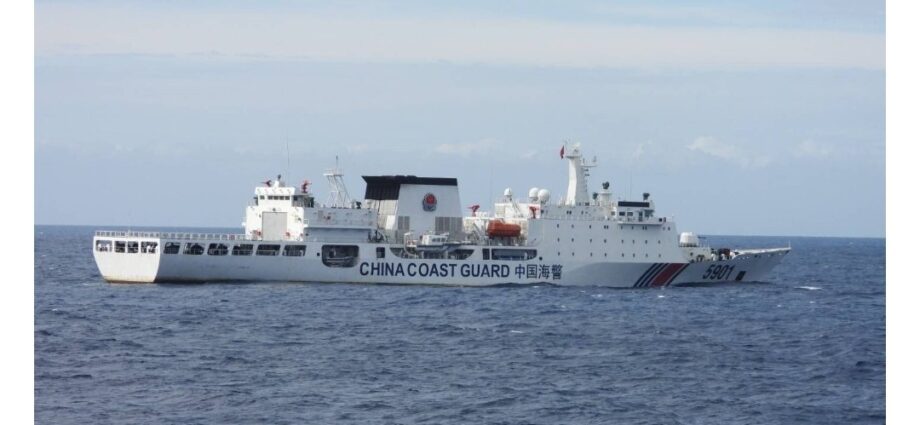
ZAMBALES, PHILIPPINES — The China Coast Guard (CCG) vessel 5901, infamously known as the “monster ship,” maintained its presence near the Philippine coast on Wednesday, defying calls from Manila for its withdrawal.
The Philippine Coast Guard (PCG) reported that its vessel, BRP Gabriela Silang, has been closely monitoring the CCG’s “illegal” deployment near Zambales, describing the Chinese vessel’s movements as failing to meet the criteria for innocent passage under international law.
“Throughout the day, the movements of the CCG vessel have not been continuous or expeditious, failing to meet the necessary criteria for exercising the right of innocent passage,” said Commodore Jay Tarriela, PCG spokesperson for the West Philippine Sea (WPS).
Close Monitoring and Tensions at Sea
In response, the BRP Gabriela Silang has maintained a protective stance, keeping the Chinese vessel at an average distance of 60 to 70 nautical miles from the Philippine coastline through what Tarriela described as “skillful seamanship.”
The CCG reportedly issued a radio challenge against the BRP Gabriela Silang, accusing it of violating the Convention on the International Regulations for Preventing Collisions at Sea (COLREGs). Tarriela, however, dismissed Beijing’s claims, stating that the CCG’s presence within the Philippines’ Exclusive Economic Zone (EEZ) is the more pressing issue.
“The PCG’s close maneuvering against the China Coast Guard vessel is vital to prevent it from approaching forward the Zambales coast,” Tarriela emphasized.
The PCG first confirmed the presence of the CCG vessel near Capones Island on January 4.
Diplomatic Protest Filed
The Philippine government has filed a diplomatic protest against China and demanded the withdrawal of the “monster ship” from Philippine waters.
“The government is alarmed by the presence of the monster ship,” said Jonathan Malaya, spokesperson for the National Task Force for the West Philippine Sea (NTF-WPS). “We have made a clear request and demand with the Chinese government to withdraw their ship. We’ll take it from there.”
China Defends Presence
In response, Chinese Foreign Ministry spokesperson Guo Jiakun defended the CCG’s actions, reiterating Beijing’s claims of sovereignty over the South China Sea.
“China’s sovereignty and rights and interests in the South China Sea were established in the long course of history, and are solidly grounded in history and law,” Guo said, maintaining that the CCG conducts “patrols and law enforcement activities in relevant waters in accordance with the law.”
Guo also called on the Philippines to “stop all infringement activities, provocations, and false accusations” and to refrain from actions that “jeopardize peace and stability.”
Rising Tensions in Disputed Waters
The incident adds to ongoing tensions as China continues to claim nearly all of the South China Sea, including areas that fall within the Philippines’ EEZ and those of neighboring countries like Vietnam, Malaysia, Indonesia, and Brunei.
In 2016, an international arbitration tribunal in The Hague ruled in favor of the Philippines, stating that China’s expansive claims in the South China Sea had “no legal basis.” China has refused to recognize the ruling.
The Philippine Coast Guard reaffirmed its commitment to safeguarding the nation’s maritime interests, emphasizing that it will continue monitoring and addressing any threats to its maritime jurisdiction and sovereignty.