
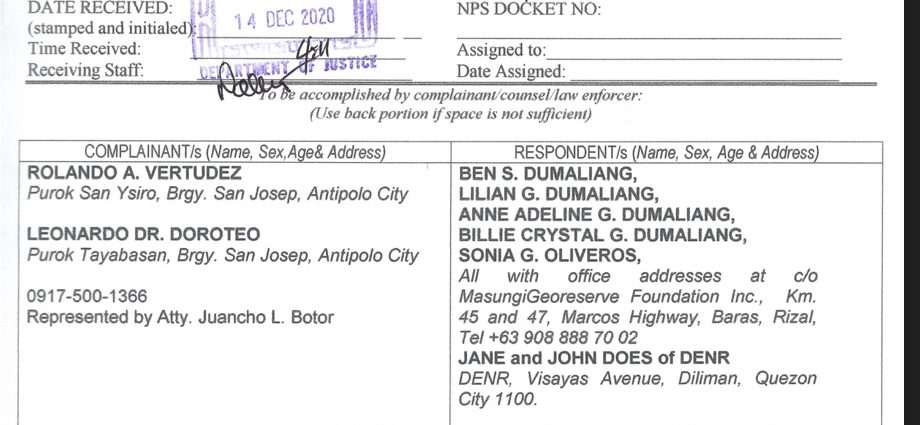
The Dumagats of Antipolo filed graft cases before the Rizal Prosecutor’s Office against the operators of the Masungi Georeserve in Baras, Rizal for alleged violation of Sections 3 (e) and (g), and 4 (b) of Republic Act 3019 or the Anti-Graft and Corrupt Practices Act.
In a 10-page complaint, named respondents by the Dumagat complainants Rolando Vertudez and Leonardo DR Doroteo were Masungi Georeserve operators Ben Dumaliang, Lilian Dumaliang, Anne Adeline Dumaliang, Billie Crystal Dumaliang, Sonia Oliveros, and several Jane and John Does from the Department of Environment and Natural Resources (DENR).
The complainants narrated that they have been occupying their ancestral land since the time of their great forefathers, which they claim is the reason why Republic Act 8371 or the Indigenous Peoples’ Rights Act of 1997 (IPRA Law) recognized them. They said that the National Commission on Indigenous Peoples (NCIP), the main implementing agency of the IPRA Law, recognized and certified them, including the issuance of land measurements and plans last January 7, 2017.
“But last October 2020, officials from the Masungi Georeserve, together with several armed and uniformed men, intruded into a portion of our ancestral domain and insisted that they are the ones who have the right to our land because of their Memorandum of Agreement (MOA) with the DENR,” they stated in their complaint.
They narrated that the MOA is defective, onerous and grossly disadvantageous to the government, which is the main subject of their suit.
The complainants claimed the MOA between Masungi and the DENR is supposedly “perpetual” in nature, which is contrary to law that sets the limit to only 25 years. By law, Masungi Georeserve is also supposed to pay the government for the use of the protected area, while records show the former is not paying the latter for the use of the protected area within its MOA. It derives its income from its business inside the area through the collection of P1,500-P1,800 entrance fees per person, apart from its income from several recreational infrastructures.
The Anti-Graft and Corrupt Practices Act (RA 3019) provides in Section 3 (e) the violation of a public official: “causing any undue injury to any party, including the Government, or giving any private party any unwarranted benefits, advantage or preference in the discharge of his official administrative or judicial functions through manifest partiality, evident bad faith or gross inexcusable negligence…(g) entering, on behalf of the Government, into a contract or transaction manifestly and grossly disadvantageous to the same, whether or not the public officer profited or will profit thereby.”
Section 4 (b), the prohibition on private individuals, states that “it shall be unlawful for any person knowingly to induce or cause any public official to commit any of the offenses defined in Section 3 hereof.”
Last December 19, 2020, DENR Assistant Secretary for Climate Change and concurrent Biodiversity Management Bureau Director Ricardo Calderon said a mere MOA cannot supersede the Expanded National Protected Areas (E-NIPAS) law. He said the MOA that supposedly legalizes the operations and occupancy of Masungi Georeserve is flawed and disadvantageous to the government.
“It is public land and, as such, the government is entitled to certain taxes and fees for its use. Imagine, having the right to use the land for ecotourism for free, without paying taxes forever,” Calderon emphasized.
Masungi Georeserve has yet to respond to the complaint.